
Stop RAG Hallucinations. Start Getting Real Answers.
GraphRAG combines deterministic graph traversals with semantic search to minimize hallucinations while maximizing explainability. Your data, structured for intelligence.
Schedule a Consultation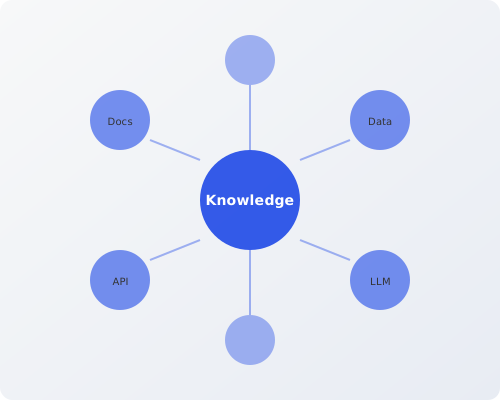


Enterprise-Grade Engineering
GraphRAG isn't just another AI wrapper. It's built on the same rigorous principles that define all NodesAI systems.

State-of-the-Art Technology
Neo4j for graph storage, LangGraph for orchestration, and cutting-edge embedding models. We use what leading engineering teams are adopting—not legacy frameworks.

Data Quality First
Entity extraction includes validation gates. Pydantic schemas enforce data contracts. Malformed documents get flagged, not silently corrupted.

Maintainable Code
Type-safe Python with strict separation of concerns. Graph operations, LLM calls, and business logic are cleanly isolated. Your team can extend and debug without reverse-engineering.

Intelligent Orchestration
LangGraph routes queries through the optimal retrieval path—graph, metadata, or vector—with full observability into every decision and fallback.
Why Your Current RAG System Fails

Hallucinations
Standard RAG treats documents as flat text. When context is ambiguous, LLMs fabricate answers instead of admitting uncertainty.

Poor Entity Resolution
Vector similarity can't distinguish "John Smith the CEO" from "John Smith the engineer" across thousands of documents.

No Explainability
When answers are wrong, you can't trace why. Black-box retrieval makes debugging and compliance impossible.
The "Skinny Graph, Fat Context" Approach
GraphRAG keeps your knowledge graph lean for efficient traversals, while rich metadata resides in complementary stores. All layers are unified through strict identity mapping.
Unlike basic RAG that matches keywords, GraphRAG understands relationships: "the CEO of Company X" and "John Smith" resolve to the same entity—even across thousands of documents.
Learn How It Works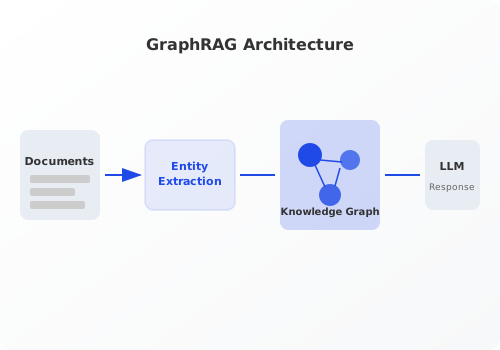
Three-Tier Retrieval Strategy

Tier 1: Graph
Deterministic facts, relationships, and topology queries via generated Cypher. Fast, precise, explainable.

Tier 2: Metadata
Rich sidecar data—specifications, documents, statistics—from structured stores linked by entity IDs.

Tier 3: Vector
Semantic and contextual searches using embeddings, with "Walled Garden" filtering to prevent drift.

Hallucination Guards
Low-confidence results return graceful "not found" rather than fabrications. Read-only query validation.

Self-Correction
Query syntax errors trigger automatic retry. Empty graph results escalate to semantic search fallback.

Full Traceability
Every answer includes the reasoning path: which tier, which query, which entities resolved.
How GraphRAG Works
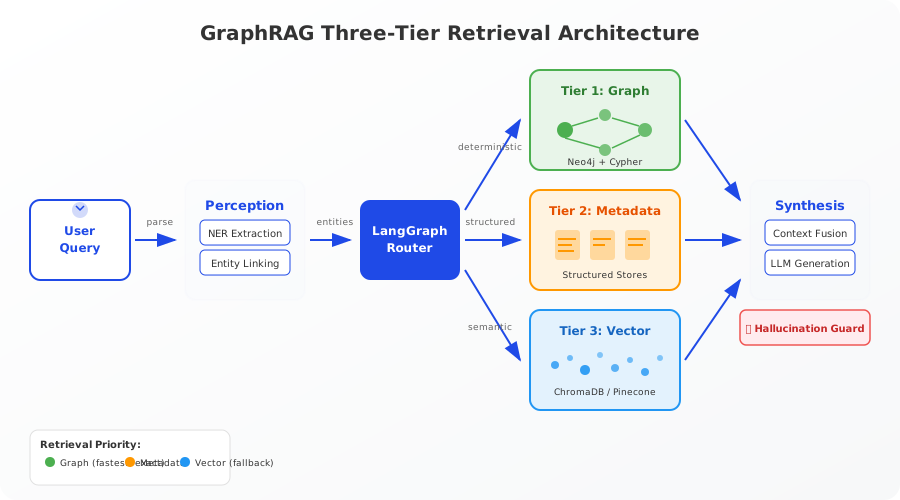
Perception
Entity extraction and disambiguation from user queries using NER.
Strategy
Router selects retrieval tier: graph, metadata, or vector search.
Execution
Specialist components execute queries against their respective stores.
Synthesis
Fusion layer synthesizes final answer from combined context.
Production-Grade Stack
🗄️ Neo4j
Enterprise graph database for entity storage, relationship mapping, and Cypher query execution.
⚡ LangGraph
State machine orchestration for complex multi-step retrieval workflows with conditional routing.
🧠 ChromaDB / Pinecone
Vector stores for semantic search with enterprise embeddings (OpenAI, Nomic, or local models).
🔧 Pydantic + Python
Type-safe configuration and data validation throughout the pipeline. Clean, maintainable code.
Industry Applications

Manufacturing
Query technical documentation, maintenance records, and engineering specs with entity-aware search.

Pharmaceutical
Navigate clinical trials, research papers, and regulatory documents with precise entity relationships.

Mining & Energy
Connect geological surveys, sensor data, and operational reports for predictive insights.

Financial Services
Build compliance-ready knowledge systems with full audit trails and data lineage.

Legal & Compliance
Search contracts, regulations, and case law with entity disambiguation across jurisdictions.

Media & Entertainment
Catalog relationships between artists, releases, and rights across complex metadata taxonomies.
The Surgeon, Not the General Practitioner
We don't build "AI chatbots." We rescue failed RAG proofs-of-concept by re-engineering the data layer with knowledge graphs and structured retrieval. If your current system hallucinates, can't resolve entities, or produces unexplainable answers—that's exactly where we start.
Every engagement has defined scope and deliverables. You're not buying hours of consulting; you're buying the absence of risk. We've built enough knowledge systems to know exactly where the problems hide.
About NodesAIWhat's Included
✓ Included
- Knowledge graph schema design
- Entity extraction and resolution pipeline
- Neo4j graph database setup and configuration
- Three-tier retrieval implementation
- LangGraph orchestration workflow
- LLM integration (OpenAI, Anthropic, or local)
- RESTful API endpoints
- Validation test suite (50+ queries)
- Documentation and training
- 30-day post-launch support
✗ Not Included
- Frontend UI development
- Data cleaning and preparation
- Ongoing cloud hosting costs
- Custom LLM fine-tuning
- Integration with legacy ERP systems
- Real-time streaming ingestion
Engagement Options
Diagnosis
2-day engagement
- Data source analysis
- Knowledge schema proposal
- Retrieval strategy design
- Technical roadmap
- Effort estimation
Implementation
4-6 week project
- Everything in Diagnosis
- Full GraphRAG system build
- Three-tier retrieval setup
- API deployment
- Validation test suite
- 30-day support included
Maintenance
per month
- System monitoring
- Performance optimization
- Knowledge graph updates
- Query tuning
- Priority support
Frequently Asked Questions
How is GraphRAG different from standard RAG?
Standard RAG retrieves documents based on vector similarity, which often misses the "big picture." GraphRAG uses a knowledge graph to understand the relationships between entities, allowing it to answer complex questions that require multi-hop reasoning.
Do I need a graph database like Neo4j?
Yes, a graph database is required to store the entities and relationships. We recommend Neo4j for enterprise deployments, but we can also work with other graph stores depending on your infrastructure.
Can I use my own LLM models?
Absolutely. Our architecture is model-agnostic. We can integrate with OpenAI, Anthropic, or locally hosted models (e.g., Llama 3) for data privacy.
How long does implementation take?
A typical pilot implementation takes 4-6 weeks. This includes data modeling, pipeline setup, and integration with your existing search interface.
Ready to Build Your Knowledge Engine?
Let's discuss how GraphRAG can transform your enterprise data into actionable intelligence.
Schedule a Free Consultation